
 "Excellent service and fast delivery"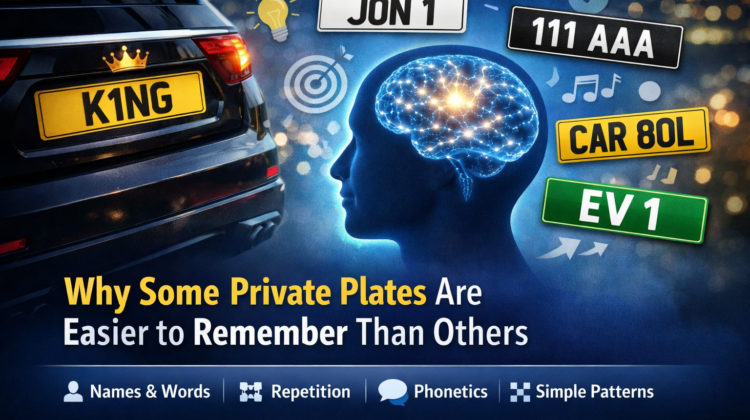
The brain doesn’t treat number plates as random strings. Instead, it looks for patterns—anything familiar, meaningful, or visually tidy.
- Chunking — We naturally break information into small, meaningful units. A plate like JON 11 is easier to remember than J14 NXX because the brain can chunk it into a name + a simple number.
- Pattern recognition — Repetition, symmetry, and rhythm make recall easier. AA11 AAA is unforgettable because it forms a perfect visual and phonetic pattern.
- Association — If a plate resembles a word, name, brand, or concept we already know, it becomes instantly memorable.
These principles explain why certain formats—especially name plates, repeating digits, and clean dateless styles—tend to dominate the “most memorable” lists.
Why phonetics matter more than people realise
Phonetic clarity is one of the strongest predictors of memorability. Plates that sound like real words or names are easier to store in memory than plates that rely on forced interpretation.
Strong phonetic examples
- SAM 1
- CAR 20L
- TAX 1
- W1 LLS
These plates map cleanly onto existing words or names. The brain doesn’t have to work.
Weak phonetic examples
- J888 MYS (James, but only if you squint)
- L4444 ARA (Laura, but not immediately obvious)
- B16 OSS (Big Boss, but visually noisy)
The more mental effort required to decode the meaning, the less memorable the plate becomes.
The power of repetition and symmetry
Repetition is one of the strongest memory cues in human cognition. That’s why repeating-digit plates are so desirable—and often expensive.
Highly memorable repeating patterns
- 111 AAA
- 22 OO
- 7 L
- OO22 OOO
These plates create rhythm and visual balance. Even if they don’t spell anything, they’re instantly recognisable.
Why symmetry works
Symmetry reduces cognitive load. Plates like A11 A or XY 22 XY feel “tidy,” and tidy information is easier to remember.
Dateless plates: the memorability king
Dateless plates are often the easiest to recall because they remove the clutter of year identifiers. Without the extra digits, the brain can focus on the meaningful part.
Why dateless plates stick
- Shorter = easier to store
- Cleaner layout = easier to recognise
- More room for meaningful combinations
- Often associated with prestige, making them more emotionally salient
This is one reason dateless plates remain popular with businesses and public figures—they’re visually simple and brand-friendly.
Emotional relevance: the hidden factor
Emotion is a memory amplifier. If a plate connects to something meaningful—your name, your business, your hobby—it becomes dramatically easier to recall.
Examples of emotionally charged plates
- DOG 1 for a pet brand
- EV 1 for an electric vehicle enthusiast
- W1 LLS for someone named Will
- CEO 1 for a business owner
Even if the plate isn’t visually perfect, emotional relevance boosts memorability.
Why spacing, alignment, and legality matter
Illegal spacing is often used to force a plate to “look” like a name—but it backfires.
Illegal spacing reduces memorability
When spacing is distorted, the brain has to work harder to decode the intended meaning. That extra effort reduces recall.
Legal spacing also ensures the plate is readable at speed, in poor weather, and by ANPR cameras—another reason memorability and compliance go hand in hand.
For a full breakdown of legal spacing rules, see DVLA plate regulations.
Cognitive friction: the enemy of memorability
Some plates are difficult to remember because they create cognitive friction—anything that slows down recognition.
Common sources of friction
- Unusual letter–number substitutions (e.g., 5 for S, 8 for B, 0 for O)
- Multiple phonetic leaps (e.g., J4 MES → James)
- Visually noisy combinations (e.g., Q, Z, and 8 together)
- Long plates with no meaningful pattern
- Forced interpretations that rely on illegal spacing
If a plate requires explanation, it’s less memorable.
Why memorable plates often hold higher investment value
Memorability isn’t just psychological—it’s financial.
Highly memorable plates tend to:
- Attract more buyers
- Hold value better
- Sell faster
- Perform well at auction
- Appeal to businesses seeking brand visibility
This is why plates like F1, VIP 1, CEO 1, and 1 O command premium prices: they’re short, clean, meaningful, and instantly recognisable.
For more on investment-grade registrations, see RegPlates – Investment Plates.
Real-world examples: memorable vs forgettable
Memorable
- K1 NGS — Clear word, strong identity
- JON 1 — Name + simple number
- 100 O — Perfect repetition
- EV 1 — Strong relevance in the electric vehicle era
Forgettable
- J14 NXX — No pattern, no meaning
- L444 RAA — Forced phonetics
- B16 OSS — Visually noisy
- AH18 YYA — Hard to chunk, no emotional anchor
To support readers exploring this topic further, here are two relevant internal resources:
- Buy Legal Private Plates — A guide to compliant, BS AU 145e‑approved acrylic plates.
- Check Plate Valuations — Useful for understanding how memorability affects market value.
For official guidance on plate formats and readability standards: DVLA – Displaying Number Plates
Final thoughts
Memorability isn’t random. It’s shaped by psychology, phonetics, visual design, and emotional relevance. The most memorable plates are simple, meaningful, and visually balanced—qualities that also make them more desirable and valuable.
Jon Cherry is a Director of leading personalised number plate dealer Regplates.com. Jon has over 25 years industry experience handling some of the most expensive plates ever sold with many high profile and celebrity clients. Active since 1991 in the number plate industry, Jon is currently Chairman of the Cherished Numbers Guild, a trade body representing number plate dealers in the UK. Jon has written many articles on the industry and insight into the future of numberplates and the market as a whole.