
 "Excellent service and fast delivery"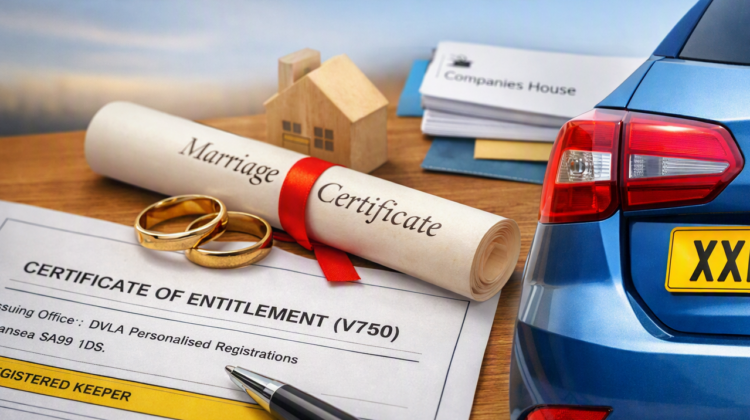
Private number plates are deeply personal assets. For many motorists, they reflect identity, heritage, or branding — whether that’s a surname, initials, business name or a carefully chosen word. But identities evolve. People change their names after marriage or divorce, companies rebrand, and sometimes the details on a V750 or V778 simply no longer match the person or organisation entitled to use the registration.
When this happens, it’s essential to update your DVLA documentation correctly. Failing to do so can cause complications when assigning, retaining, selling or transferring your private plate. This guide explains exactly what to do when the name connected to your plate no longer fits — covering personal name changes, business rebrands, nominee updates, and how to amend V750/V778 details.
Why Accurate DVLA Details Matter
Your V750 Certificate of Entitlement (for plates you’ve purchased but not yet assigned) and your V778 Retention Document (for plates you’ve taken off a vehicle) are legal proof that you have the right to use a registration. If the name on these documents is outdated or incorrect, DVLA may refuse:
- Assignment to a vehicle
- Transfer to another keeper
- Renewal of the certificate
- Nominee changes
- Sale or gifting of the registration
The DVLA is strict: the name on the entitlement document must match the legal identity of the person or business with the rights to the plate.
1. Personal Name Changes: Marriage, Divorce, Deed Poll
Personal name changes are the most common reason entitlement documents need updating. Whether you’ve taken a partner’s surname, reverted to a maiden name, or changed your name by deed poll, DVLA requires formal proof before issuing an updated V750 or V778.
How to update your name on a V750 or V778
You can only update your name by post. DVLA does not offer an online name‑change service for personalised registrations.
Send DVLA:
- Your current V750 or V778
- A signed covering letter explaining your new name
- Proof of the name change, such as:
- Marriage or civil partnership certificate
- Divorce or dissolution documents (decree absolute, final order)
- Deed poll certificate
Address: DVLA Personalised Registrations, Swansea, SA99 1DS
If you no longer have your V750 or V778, include an explanation and provide proof of identity and your name change. DVLA will issue a replacement certificate once processed.
What happens next?
DVLA will send you a new V750 or V778 showing your updated name. When it arrives, destroy all previous versions, as older documents become invalid and cannot be used for online services.
2. Business Rebrands: Updating Company Names on Entitlement Documents
Private plates are often used by businesses for fleet branding, marketing consistency, or prestige. When a company changes its name — whether through rebranding, merger, or restructuring — the entitlement documents must be updated to reflect the new legal entity.
What DVLA requires for business name changes
Send DVLA:
- The V750 or V778
- A signed letter on company letterhead explaining the change
- Proof of the new business name, such as:
- Certificate of incorporation on change of name
- Companies House documentation
- Evidence of merger or acquisition
The DVLA will then issue updated entitlement documents showing the new business name.
Why this matters for fleets
If your business assigns plates across multiple vehicles, outdated documentation can cause delays when:
- Assigning plates to new vehicles
- Moving plates between fleet vehicles
- Selling vehicles with private registrations
- Renewing retention documents
Keeping entitlement documents aligned with your current trading name ensures smooth DVLA processing and avoids administrative bottlenecks.
3. Updating Nominee Details When the Plate Is Intended for Someone Else
If you bought a plate for someone else — a family member, friend, or business partner — you may have added them as a nominee on the V750 or V778. If their name has changed, or if the plate is now intended for a different person, you must update the nominee details.
How to change a nominee
Complete Section 2 of the V750 or V778 with the new nominee’s details and send it to DVLA.
DVLA will issue an updated certificate showing the new nominee. This ensures the plate can be assigned to their vehicle without complications.
4. Address Changes: When the Name Fits but the Location Doesn’t
If your name is correct but your address has changed, DVLA requires an update — but the process differs depending on whether the plate is assigned to a vehicle.
If the plate is already assigned to a vehicle
You only need to update the address on your V5C log book, not the V750/V778.
If the plate is not assigned
You must update the address on the V750 or V778 either:
- Online (V750 only), or
- By post (V750 or V778)
Proof of address may be required if you no longer have the original document.
5. When You Don’t Have Your V750 or V778
Lost entitlement documents are common, especially if the plate has been held for many years. DVLA can still update your details, but you must provide:
- A signed letter explaining why the document is missing
- Proof of your identity
- Proof of your name or address change
DVLA will issue a replacement certificate once processed.
6. How Name Changes Affect Assigning, Retaining, or Selling a Plate
Assigning a plate to a vehicle
When assigning a plate, DVLA checks:
- The V750/V778 details
- The V5C details
- The nominee (if applicable)
Retaining a plate
If you remove a plate from a vehicle and place it on retention, DVLA will issue a V778. If your name has changed since the original V750 was issued, update the details before or immediately after retention.
Selling or gifting a plate
If you sell or give a plate to someone else, DVLA requires accurate entitlement documents to complete the transfer. Outdated names can cause delays or require additional proof.
7. How to Avoid Problems in Future
- Keep digital copies of your V750/V778 for reference (but never share them publicly).
- Update DVLA immediately after any name or address change.
- Ensure business records match DVLA documentation.
- Destroy old certificates when new ones arrive.
- Keep proof of name changes accessible for future DVLA requests.
8. Internal & External Resources
For further help, RegPlates.com offers detailed guides on DVLA processes, including:
- How to Transfer a Private Number Plate
- Understanding V750 and V778 Documents
And for official DVLA instructions, visit: Private Plates: Change Your Name (GOV.UK)
When the name connected to your private plate no longer fits, updating your DVLA documentation is essential. Whether it’s a personal name change, a business rebrand, or a nominee update, the process is straightforward — but must be done correctly to avoid delays or complications.
Your private plate is part of your identity. Keeping your V750 or V778 up to date ensures you can continue using, transferring, or selling your registration smoothly and legally.
Jon Cherry is a Director of leading personalised number plate dealer Regplates.com. Jon has over 25 years industry experience handling some of the most expensive plates ever sold with many high profile and celebrity clients. Active since 1991 in the number plate industry, Jon is currently Chairman of the Cherished Numbers Guild, a trade body representing number plate dealers in the UK. Jon has written many articles on the industry and insight into the future of numberplates and the market as a whole.