
 "Excellent service and fast delivery"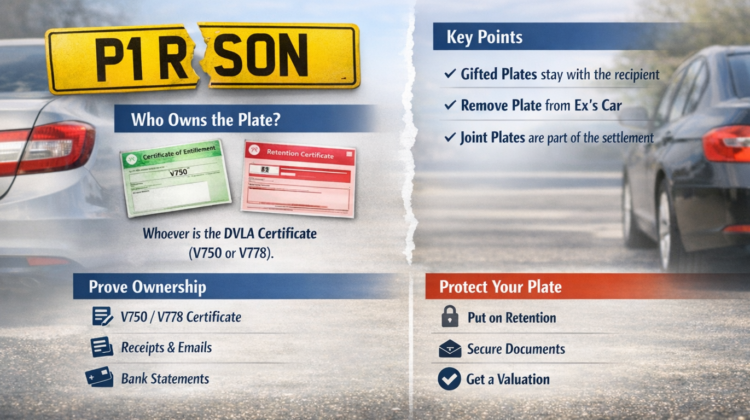
Private number plates are more than just vehicle identifiers — they’re assets. They hold monetary value, emotional value, and in many cases, investment value. So when a relationship breaks down, one question often surfaces quickly:
Who actually owns the private plate?
Divorce and separation already involve enough complexity without adding DVLA rules, V5C documents, retention certificates, and asset‑splitting negotiations into the mix. But the good news is this: private plate ownership is usually very clear if you know what to look for.
This guide breaks down exactly what happens to a private plate during a divorce or separation, how ownership is legally determined, and the steps you can take to protect your rights.
1. The Key Principle: The Registered Keeper Is Not the Owner
This is the single biggest misunderstanding in plate disputes.
The name on the V5C logbook is not the legal owner of the registration number. The DVLA states this clearly: the registered keeper is simply the person responsible for taxing and maintaining the vehicle.
Ownership of the private plate depends on one thing only: Whose name is on the DVLA certificate for the registration mark.
That means:
- If the plate is on a vehicle, the owner is the person named on the V750 (Certificate of Entitlement) or V778 (Retention Certificate).
- If the plate was purchased as a gift, ownership depends on whose name was entered as the grantee or nominee.
- If the certificate is in your name, the plate is legally yours — regardless of who drives the car.
This distinction becomes crucial during divorce proceedings.
2. How Private Plates Are Treated in Divorce Settlements
Private plates are considered personal property or assets, similar to jewellery, watches, or artwork. Their value can range from a few hundred pounds to six‑figure sums, so they can absolutely form part of a financial settlement.
Courts typically consider:
- Who paid for the plate
- Whose name is on the certificate
- Whether it was intended as a gift
- Whether it has significant resale value
- Whether it is attached to a vehicle that is also being divided
If the plate is worth more than £1,000, solicitors often recommend getting a valuation — something RegPlates.com can help with.
3. Common Scenarios and How They’re Resolved
Scenario A: The Plate Is Registered to One Partner Only
This is the simplest situation.
If the V750 or V778 is in your name, the plate is yours. If it’s in your partner’s name, it’s theirs.
Even if:
- You paid for the plate
- You put it on your car
- You’ve used it for years
The DVLA will not transfer ownership without the certificate holder’s consent.
Scenario B: The Plate Was a Gift
This is where disputes often arise.
If you bought a plate for your partner and registered it in their name, it is legally considered a completed gift. You cannot reclaim it simply because the relationship has ended.
If you bought a plate for yourself but registered your partner as the nominee, you remain the owner — nominees have no ownership rights.
Scenario C: The Plate Is on a Car Owned by the Other Partner
This is extremely common.
If your plate is on your ex‑partner’s car, you still own the plate — but you must remove it before the vehicle is sold or transferred.
You can do this by:
- Applying online to retain the plate (V778)
- Transferring the plate to another vehicle
- Moving it to a retention certificate
If your ex refuses to cooperate, you may need legal assistance, because the DVLA will not intervene in ownership disputes.
Scenario D: The Plate Is Jointly Purchased
Joint ownership is not recognised by the DVLA.
Only one name can appear on the certificate.
If both partners contributed financially, the plate becomes part of the financial settlement, and one partner may:
- Buy out the other’s share
- Agree to sell the plate and split the proceeds
- Transfer ownership as part of the settlement
4. How to Prove Ownership During a Dispute
To establish ownership, you’ll need:
- The V750 Certificate of Entitlement (if the plate was never assigned)
- The V778 Retention Certificate (if the plate was removed from a vehicle)
- A DVLA confirmation letter or email
- Purchase receipts or invoices
- Bank statements showing payment
- Emails confirming who the plate was intended for
If you don’t have the certificate, you can request a replacement from the DVLA — but only if you are the recorded owner.
5. What If the Certificate Is Missing?
This is common in long relationships where paperwork gets misplaced.
If the certificate is lost, the DVLA can issue a replacement only to the person listed as the grantee.
If your ex is the grantee, they can request a replacement without your involvement.
If you are the grantee, your ex cannot request one.
This is why keeping certificates safe is essential — especially during a separation.
6. Can a Partner Remove or Transfer the Plate Without Consent?
If they are the certificate holder, yes.
If they are not, no.
The DVLA will not allow:
- Transfers
- Retentions
- Assignments
- Sales
…unless the request comes from the legal owner.
If you believe your plate has been transferred without your consent, you must contact the DVLA immediately. They may investigate, but they will not resolve ownership disputes — that is a civil matter.
7. Protecting Your Plate During a Divorce
Here are practical steps to safeguard your registration:
1. Secure the Certificate
If the V750 or V778 is in your name, store it somewhere safe.
2. Move the Plate to Retention
This removes it from any shared vehicle and places it under your sole control.
3. Update Your DVLA Contact Details
Ensure all DVLA correspondence comes directly to you.
4. Get a Professional Valuation
This is especially important if the plate is rare, dateless, or name‑based. RegPlates.com offers guidance on plate values and investment potential — see our page on dateless number plates for more insight.
5. Document Everything
Keep emails, receipts, and DVLA confirmations.
8. When the Court Gets Involved
If the plate is valuable or disputed, solicitors may include it in the financial settlement. Courts can order:
- The plate to be sold
- One partner to transfer ownership
- One partner to compensate the other
However, the DVLA will only act once the court order is provided.
9. Selling the Plate After a Divorce
Many people choose to sell a plate after a separation — either to release funds or simply to move on.
RegPlates.com can help with:
- Valuation
- Marketing
- Secure transfer
- Handling DVLA paperwork
You can explore more about how private plates hold value on our page about number plates as investments.
10. Useful External Resource
For official DVLA guidance on private plate ownership and transfers, see: DVLA Personalised Registrations
Private plates can be emotionally charged assets during a divorce or separation, but the legal position is usually straightforward: ownership follows the certificate, not the vehicle.
Jon Cherry is a Director of leading personalised number plate dealer Regplates.com. Jon has over 25 years industry experience handling some of the most expensive plates ever sold with many high profile and celebrity clients. Active since 1991 in the number plate industry, Jon is currently Chairman of the Cherished Numbers Guild, a trade body representing number plate dealers in the UK. Jon has written many articles on the industry and insight into the future of numberplates and the market as a whole.