
 "Excellent service and fast delivery"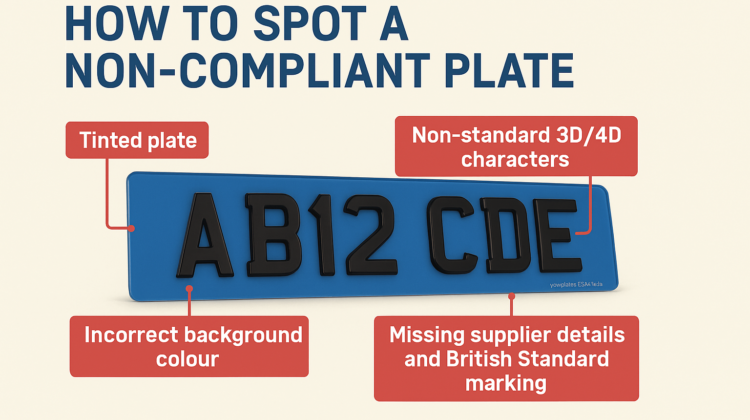
Number plates have become a style statement as much as a legal requirement. From bold 4D laser‑cut characters to tinted acrylic and custom fonts, the market is full of eye‑catching options. But with that choice comes confusion — and, unfortunately, a flood of sellers advertising plates as “road‑legal” when they’re anything but.
For motorists, the consequences of fitting non‑compliant plates can be costly: fines, MOT failures, and even ANPR misreads that lead to wrongful penalties. For traders, the reputational risk is just as serious. That’s why understanding the difference between legal, borderline, and outright illegal plates is essential.
This guide breaks down the key rules, the common myths, and the fastest ways to spot non‑compliant plates before they cause trouble.
What Makes a Number Plate Road‑Legal?
The UK’s number plate regulations are set out by the DVLA and the British Standard (currently BSAU 145e). To be road‑legal, a plate must meet strict requirements on:
- Font (Charles Wright)
- Character size and spacing
- Reflectivity
- Material durability
- Colour (white front, yellow rear)
- No background patterns
- No tinted or obscured surfaces
- Supplier name and postcode
- British Standard marking
The DVLA provides full guidance on these requirements here: DVLA – Number Plate Rules.
If a plate fails on any of these points, it’s not legal for road use — even if the seller claims otherwise.
Show Plates vs Road‑Legal Plates: The Crucial Difference
“Show plates” are decorative plates intended for off‑road use only — exhibitions, garages, photoshoots, or private land. They often feature:
- Custom fonts
- Tinted acrylic
- Logos or flags not permitted by DVLA
- Non‑standard spacing
- Shortened formats
- Blacked‑out or gel backgrounds
These plates cannot be used on public roads under any circumstances.
The problem? Many online sellers blur the line, using phrases like:
- “Road‑legal style”
- “MOT‑friendly”
- “Legal with disclaimer”
- “For show use (but fine for road use)”
These are red flags. A plate is either compliant or it isn’t — there’s no grey area in the eyes of the law.
Are 3D and 4D Plates Legal?
Yes — 3D and 4D plates can be road‑legal, but only if they meet every DVLA requirement.
Legal 3D/4D plates must:
- Use the standard Charles Wright font
- Have black characters only
- Maintain correct character height, width, and spacing
- Be mounted on untinted, reflective acrylic
- Include the supplier name/postcode and BSAU 145e mark
- Not use raised characters so thick that they distort readability
Common illegal variations include:
- Tinted plates
- Carbon‑fibre effect characters
- Neon, coloured, or glitter gel characters
- Overly thick 4D layers
- Mis‑spaced characters to mimic a different registration
- Missing supplier details or British Standard markings
If any of these features appear, the plate is not road‑legal — regardless of what the seller claims.
How to Spot Non‑Compliant Plates in Seconds
Whether you’re a motorist checking your own plates or a trader reviewing customer orders, these quick checks will help you identify illegal plates fast.
1. Look for the British Standard Marking (BSAU 145e)
This is the quickest giveaway. If the plate doesn’t show BSAU 145e, it is automatically illegal for road use.
2. Check for Supplier Name and Postcode
DVLA requires the plate maker’s details to be printed on the plate. If missing, the plate fails compliance instantly.
3. Inspect the Acrylic for Tinting
Even a light smoke tint is illegal. Road‑legal plates must be fully reflective and untinted.
4. Examine the Font and Spacing
The Charles Wright font is mandatory. Common illegal variations include:
- Slim or stretched characters
- Italic or stylised fonts
- Mis‑spaced characters to spell words
If spacing looks “too good to be true”, it probably is.
5. Check the Character Style
Legal 3D/4D plates use black characters only. If you see:
- Carbon fibre
- Glitter
- Neon colours
- Multi‑layered characters thicker than 4mm
…it’s not compliant.
6. Look for Background Patterns
Legal plates must have a plain background. Any pattern, texture, or printed design is illegal.
7. Confirm Reflectivity
Road‑legal plates must reflect light correctly. Show plates often use matte or non‑reflective materials.
Why Non‑Compliant Plates Are a Bigger Risk Than People Realise
Many drivers assume the worst that can happen is a £100 fine. In reality, the consequences can be far more serious.
1. MOT Failure
Non‑compliant plates are an instant MOT fail. Even minor issues like incorrect spacing or missing markings will cause rejection.
2. ANPR Misreads
Automatic Number Plate Recognition systems rely on strict formatting. Illegal plates can cause:
- Congestion charge penalties
- Incorrect speeding fines
- Parking enforcement errors
- Police stops
3. Police Fines and Vehicle Seizure
Driving with illegal plates can lead to:
- £100 on‑the‑spot fines
- Orders to replace plates immediately
- Vehicle seizure in extreme cases
4. Insurance Complications
If a vehicle is involved in an incident and found to have illegal plates, insurers may argue non‑disclosure of modifications.
5. Reputational Damage for Traders
For plate suppliers, selling non‑compliant plates as “road‑legal” can lead to:
- Customer complaints
- Chargebacks
- DVLA scrutiny
- Loss of trust
Why Some Sellers Mislead Buyers
The number plate market is competitive, and some sellers use vague or misleading language to boost sales. Common tactics include:
“Road‑legal with disclaimer”
If a seller says a plate is legal but adds a disclaimer, it’s not legal.
“Legal if used responsibly”
Compliance isn’t about behaviour — it’s about the plate itself.
“Passed MOT before”
MOT testers vary, but the law does not. A plate that slipped through once can still be illegal.
“DVLA approved materials”
Using compliant materials doesn’t make the finished plate legal.
“Legal font but custom spacing”
Spacing is just as important as the font.
If a seller uses any of these phrases, treat the product as a show plate.
How Reputable Suppliers Protect Customers
Trusted suppliers — including RegPlates.com — follow strict processes to ensure compliance:
- Using only DVLA‑approved materials
- Printing correct supplier details and BSAU markings
- Maintaining accurate spacing and font standards
- Rejecting illegal customisation requests
- Providing clear guidance to customers
For motorists wanting to learn more about legal registrations, this guide is a useful starting point: How to Buy a Private Number Plate
And for those exploring plate styles safely, this page helps clarify options: 3D & 4D Number Plates Explained.
The Fastest Way to Stay Compliant
If you want to avoid fines, MOT issues, or misleading sellers, follow these simple rules:
- Buy from reputable suppliers
- Avoid tinted, coloured, or stylised plates
- Check for BSAU 145e and supplier details
- Stick to standard spacing
- Treat “show plates” as off‑road only
- When in doubt, check DVLA guidance
Compliance isn’t complicated — but misinformation makes it seem that way. With a few quick checks, you can spot illegal plates instantly and avoid the pitfalls that catch so many drivers out.

Jon Cherry is a Director of leading personalised number plate dealer Regplates.com. Jon has over 25 years industry experience handling some of the most expensive plates ever sold with many high profile and celebrity clients. Active since 1991 in the number plate industry, Jon is currently Chairman of the Cherished Numbers Guild, a trade body representing number plate dealers in the UK. Jon has written many articles on the industry and insight into the future of numberplates and the market as a whole.